I should have seen this coming. The Disney Channel Original Movie phenomenon, "High School Musical," will be getting a reboot with a new film starring a new cast. It's set to air in 2012, a scant six years after the debut of the 2006 original. I'm not sure if I missed the announcement somewhere in the flurry of television upfronts a few weeks ago, or if the news emerged sometime before that. I've found a 2008 press release confirming the existence of a "High School Musical 4" project, but nothing about it transmogrifying into a reboot before the Jim Hill Media post I stumbled across last night. This makes Sony's "Spider-Man" reboot plans seem positively lead-footed in comparison.
Let me make one thing clear. I've never seen "High School Musical." I'm totally unfamiliar with any of the recent crop of Disney Channel tween properties except from what I hear from my younger cousins, and their commiserating parents. I've managed to avoid listening to any of the music. I don't think I've encountered any performances by the young actors involved, with the exception of Zac Efron's minor role in the 2007 "Hairspray" remake. Thus I make no judgments as to quality or worthiness of the franchise one way or the other. I have no great opinion of the Disney child-star factory, which has been in operation since the Mickey Mouse Club days, but the product being turned out could be phenomenal for all I know. It certainly keeps its eight-year-old target audience happy.
And the eight-year-old target audience is exactly why I think Disney is going to get away with this without much resistance, and why I find myself shrugging off the decision more easily than I would if it were a franchise aimed at grown-ups. Children's entertainment is so specifically targeted to certain age groups, the turnover in viewers is much quicker. With adult audiences, the current crop of remakes and reboots are all based on properties from the 80s, which means it takes about thirty years or roughly a generation for memories of a once successful property to fade. With kids, who have much shorter attention spans, a new audience comes along every time the current crop ages out. The original fans of "High School Musical" are now actually high school aged themselves – so they're not likely to have much interest in the idealized, sanitized rock'n'roll version any longer. But their younger siblings will.
I suspect the new "High School Musical" film will actually be more of a spinoff than a reboot proper, using the same formula as the original but following new characters. One of the secondary "High School Musical" debutantes, Sharpay, is getting her own TV movie soon with the original actress, so Disney doesn't want us to forget about the alumni of the first film series quite yet. There's precedence for TV franchises trying to carry on in a similar fashion: "Saved By the Bell: The New Class," premiered only four years after the original "Saved By the Bell." The various iterations of "Power Rangers" stopped trying to maintain an ongoing continuity after the first few years, because most of the original viewers had aged out of the audience.
What does concern me is the likelihood that these shorter and shorter reboot cycles in feature films is indicative of some worrying trends – that the target audience for some big franchises are starting to skew much younger, and our entertainment in general is getting more niche and more age-specific. Sony's new "Spider-Man" is being aimed at high-schoolers, the same bunch that is just aging out of the "High School Musical" audience. I can just imagine kids in the future having all their media consumption planned out for them from birth, from Sesame Street as toddlers to the umpteenth reboots of either "Sex and the City" or "Wild Hogs" when they hit their forties, depending on their preferences. And no doubt we'll be able to follow our favorite actors along similarly predetermined career paths. Just imagine Zac Efron and Vanessa Hudgens reuniting in a few years to remake "Knocked Up" while Seth Rogen and Katherine Heigl reboot "Date Night."
To a degree I know this already happens, but it feels like the categories are getting narrower and more rigidly defined than ever. When I was the right age to be watching "High School Musical" guess what my favorite show was? "Golden Girls." It was how my mother and I bonded on Saturday nights, enjoying the shenanigans of four lively old ladies living it up in Miami together.
Now there's a show that will probably never get a reboot. Thank goodness.
Monday, June 7, 2010

Sunday, June 6, 2010
Frightful Financial Futures in Film
Another lackluster weekend at the box office has Hollywood in glum mood. By all accounts May was a severe disappointment for the industry, with several major summer tentpole films failing to catch fire, and underperforming initial box office projections. There have been no breakout hits so far, of the kind we saw in winter and spring, and nothing to match the hits of previous years like "Transformers," "Iron Man," and "Star Trek." There have been similarly weak starts to the summer season before, but this year feels especially dismal because expectations were running so high. Now imagine how much worse it would have been if the proposed Hollywood box office receipts futures exchange were up and running.
Inherently there's nothing wrong with trading film futures. I've heard about all the potential benefits. Futures trading may give Hollywood getting a new source of income, help hedge against risks, and give more power and influence to major studios. Wall Street trades in all sorts of exotic financial instruments and futures for a variety of commodities. Also, a popular fantasy version has existed for years – the Hollywood Stock Exchange or HSX – that allows players to buy and sell fake contracts on the performance of upcoming film projects, actors, directors, television shows, and related options. I have an account with HSX myself. It's a fun diversion, and I can understand why users would be tempted to try and translate the system to the real world.
But in the real world, box office receipts don't make for a very good commodity, and HSX with real money would essentially be legalized betting on a film's performance. The current online game bases the pricing of contracts on the first four weeks of box office returns. The proposed Media Derivatives Inc (MDEX) Trend Exchange for the "popcorn prediction market" looks pretty close to this. Up to six months in advance, they plan to sell contracts for a film's performance with price determined by grosses during the first two weeks or opening weekend of release.
Think of the potential consequences. Once tied to this kind of futures trading, a film's success or failure would be all but decided after only one weekend, which would give an advantage to front-loaded blockbusters rather than slow-and-steady performers like "How to Train Your Dragon" or prestige pictures that see attendance rise after major award wins. We would see even more emphasis on marketing campaigns to get audiences into theaters, and studios would have more incentive to produce only low-risk projects like sequels and reboots. And as the recent crop of middling summer fare has proven, this is not a strategy that audiences are embracing. If the exchange was in place today, Hollywood's recent losses would have had far further reaching financial impact.
The regulation of financial information about such trades would run into all kinds of problems. Hollywood runs on hype and gossip, and filmmakers have to oversell their films as a matter of course. Marketing campaigns often turn out to be misrepresentative, and advance buzz can evaporate overnight. Just this weekend, "Splice" was supposed to be a strong performer based on good critical reaction and a lot of interest from fanboy sites like Aint it Cool News. Out of the four films that premiered this weekend, it not only came in dead last with a box office take of $7.5 million dollars, despite a fairly pervasive marketing campaign, but audiences hated it. According to the market research firm Cinemascore, viewers gave it a rare D grade. But can you imagine the film industry sans the hype?
Also, box office receipts are notoriously easy to manipulate. There have been countless instances of studios overestimating their films' weekend grosses to drum up publicity and garner attention in the short term, only for the actual numbers to fall short. News outlets always publish the predictions ahead of the actuals for the sake of their headlines, which has allowed this sort of fudging to perpetuate. And Hollywood's accounting has always been less than transparent. Think of all the lawsuits where massive blockbusters apparently never turned a profit , thus denying rights holders or creative talent their share. Even figuring out whether a film is a hit can be a tricky business, when "Robin Hood" takes over $200 million worldwide and is pegged as a flop, while "Letters to Juliet" pulls $75 million over the same time frame and is considered a modest hit.
I don't think May would have been as nearly as bad for Hollywood if it weren't for the sky-high expectations. For years, sequels were expected to do worse than the films they followed, not better. But now despite "Iron Man 2" and "Shrek Forever After" making plenty of box office bank and guaranteeing a profit for their respective studios, both have been unable to escape the taint of disappointment because they didn't do what the financial analysts said they would – exceed or match the performance of their predecessors. If there were more money behind those predictions, I'm sure the perceived failure would be even worse. It's bad enough the stock prices for the studios keep dropping every time a picture has a bad first weekend, but at least those have a chance to recover in the long term if performance improves.
But these new movie futures? Not so much.
Inherently there's nothing wrong with trading film futures. I've heard about all the potential benefits. Futures trading may give Hollywood getting a new source of income, help hedge against risks, and give more power and influence to major studios. Wall Street trades in all sorts of exotic financial instruments and futures for a variety of commodities. Also, a popular fantasy version has existed for years – the Hollywood Stock Exchange or HSX – that allows players to buy and sell fake contracts on the performance of upcoming film projects, actors, directors, television shows, and related options. I have an account with HSX myself. It's a fun diversion, and I can understand why users would be tempted to try and translate the system to the real world.
But in the real world, box office receipts don't make for a very good commodity, and HSX with real money would essentially be legalized betting on a film's performance. The current online game bases the pricing of contracts on the first four weeks of box office returns. The proposed Media Derivatives Inc (MDEX) Trend Exchange for the "popcorn prediction market" looks pretty close to this. Up to six months in advance, they plan to sell contracts for a film's performance with price determined by grosses during the first two weeks or opening weekend of release.
Think of the potential consequences. Once tied to this kind of futures trading, a film's success or failure would be all but decided after only one weekend, which would give an advantage to front-loaded blockbusters rather than slow-and-steady performers like "How to Train Your Dragon" or prestige pictures that see attendance rise after major award wins. We would see even more emphasis on marketing campaigns to get audiences into theaters, and studios would have more incentive to produce only low-risk projects like sequels and reboots. And as the recent crop of middling summer fare has proven, this is not a strategy that audiences are embracing. If the exchange was in place today, Hollywood's recent losses would have had far further reaching financial impact.
The regulation of financial information about such trades would run into all kinds of problems. Hollywood runs on hype and gossip, and filmmakers have to oversell their films as a matter of course. Marketing campaigns often turn out to be misrepresentative, and advance buzz can evaporate overnight. Just this weekend, "Splice" was supposed to be a strong performer based on good critical reaction and a lot of interest from fanboy sites like Aint it Cool News. Out of the four films that premiered this weekend, it not only came in dead last with a box office take of $7.5 million dollars, despite a fairly pervasive marketing campaign, but audiences hated it. According to the market research firm Cinemascore, viewers gave it a rare D grade. But can you imagine the film industry sans the hype?
Also, box office receipts are notoriously easy to manipulate. There have been countless instances of studios overestimating their films' weekend grosses to drum up publicity and garner attention in the short term, only for the actual numbers to fall short. News outlets always publish the predictions ahead of the actuals for the sake of their headlines, which has allowed this sort of fudging to perpetuate. And Hollywood's accounting has always been less than transparent. Think of all the lawsuits where massive blockbusters apparently never turned a profit , thus denying rights holders or creative talent their share. Even figuring out whether a film is a hit can be a tricky business, when "Robin Hood" takes over $200 million worldwide and is pegged as a flop, while "Letters to Juliet" pulls $75 million over the same time frame and is considered a modest hit.
I don't think May would have been as nearly as bad for Hollywood if it weren't for the sky-high expectations. For years, sequels were expected to do worse than the films they followed, not better. But now despite "Iron Man 2" and "Shrek Forever After" making plenty of box office bank and guaranteeing a profit for their respective studios, both have been unable to escape the taint of disappointment because they didn't do what the financial analysts said they would – exceed or match the performance of their predecessors. If there were more money behind those predictions, I'm sure the perceived failure would be even worse. It's bad enough the stock prices for the studios keep dropping every time a picture has a bad first weekend, but at least those have a chance to recover in the long term if performance improves.
But these new movie futures? Not so much.
Saturday, June 5, 2010
Nine Fairy Tale Films I Want to See
Yesterday's announcement about Brett Ratner's plan for a "Snow White" movie got me thinking. If the next big trend is going to be fairy tales, I'm fully supportive. Fairy tales are a rich source of material, exist in the public domain, and many are quite a bit deeper and more interesting than we might remember. Here are nine fairy stories and folk tales I'd like to see as films, with some suggestions for translating them to the silver screen:
"Hansel and Gretel" – If a director really wants to get dark and edgy, it might be time to finally tackle a film version of this familiar tale of two small children in peril. To date the most notable film version of the story is a 1954 stop-motion animated film based in the Englebert Humperdink opera. I guess the gruesome prospect of cannibalism has kept most lily-livered creative types at bay, but it's high time one of these so-called horror auteurs really gave us something to squirm about. And who didn't squirm at the thought of that wicked old witch fattening up kids like Christmas turkeys on all that gingerbread?
"Rumpelstitskin" – The story always struck me as a lighter version of "Faust," only with a female protagonist and an unambiguously happy ending. It would be easy to go in darker directions, but a modern comedic version could also be fun, in the vein of something like "Bedazzled." In the garish age of crass "Sex and the City" style consumerism, where spinning straw into gold seems like child's play compared to some of the antics Wall Street investment bankers get up to, we could use a rags-to-riches tale with a cautionary twist.
"The Boy who Drew Cats" – This Japanese folktale about a boy whose drawings come to life to help him out in a pinch seems like such an obvious candidate for cinematic translation, I'm surprised that no one's ever done it – or even something with a similar concept. We've seen some Western variations like "Harold and the Purple Crayon," and a memorable episode of "Amazing Stories," but I'd love to see a film adaptation that retains the Japanese setting and finds a way to incorporate the ink-and-brush painting style.
"Jack and the Beanstalk" – Probably the best bet for a traditional action spectacular. Just imagine the potential of man versus giant on an IMAX screen. Sure "Clash of the Titans" might have given us a brief taste of 3D battles with twelve-story monsters, but nobody has ever done justice to a giant on the big screen in years. This would be a great chance to really make use of the new 3D technology. There's also plenty of sequel potential – I always wanted to find out what happened when the giants descended to Earth to take their revenge on Jack.
"Beauty and the Beast" – It's been nearly twenty years since the animated version, a lifetime since Jean Cocteau's great cinematic version, and far too long since the television series with Linda Hamilton and Ron Perlman went off the air. It's high time for another one. Recently I've noticed that every time a rugged action hero falls for an alien princess in "Avatar" or "V," it all feels too easy. How about a gender-swapped science-fiction retelling that fakes out the audience by looking like a standard survival flick at first glance?
"Aladdin" – After the egregious whitewashing of "Prince of Persia" and "The Last Airbender" this summer, Hollywood could try to make it up to the displaced ethnic actors by giving an Arabian fantasy film another shot. In some versions of the story Aladdin is Chinese, and in some he's Middle Eastern, so filmmakers have some options. We can even have the token magical white guy in the form of the Genie of the Lamp if they're really struggling for a marquee name. Hey, it worked with Johnny Depp in "Alice in Wonderland."
"The Snow Queen" – Disney had an animated version in pre-production, which was canceled after "The Princess and the Frog" underperformed. It's an awful shame, because Hans Christian Anderson's story could easily become a gorgeous adventure epic. A young heroine tromping through frozen fantasy kingdoms to rescue a missing friend might sound too close to "The Golden Compass" for some, but there are no complex religious themes or polar bears to contend with. And it's got goblins.
"Anansi" – The trickster spider-god is one of the best loved of the African pantheon and it's too bad that more people in the west aren't familiar with him. Sometimes Anansi is the hero and sometimes the villain, but he functions best as a cunning underdog who just can't stay out of trouble – but always finds a way to outsmart his enemies. An enterprising studio willing to take a shot on an African-American lead fantasy film could find no better source material. And there's already a very good modern take on the character - Neil Gaiman's wonderful "Anansi Boys."
"Storyteller" – Finally, I'd love to see a big screen translation or expansion of any of the stories from Jim Henson's "Storyteller" series, a cult children's program from the early '90s that featured many familiar actors like Miranda Richardson, Sean Bean, and Jane Horrocks. John Hurt narrated each installment as the storyteller of the title, telling original stories scripted by the late, great Anthony Minghella, all based on traditional tales. My favorites included "The Heatless Giant," "Sapsorrow," "The Soldier and Death," and "The True Bride."
"Hansel and Gretel" – If a director really wants to get dark and edgy, it might be time to finally tackle a film version of this familiar tale of two small children in peril. To date the most notable film version of the story is a 1954 stop-motion animated film based in the Englebert Humperdink opera. I guess the gruesome prospect of cannibalism has kept most lily-livered creative types at bay, but it's high time one of these so-called horror auteurs really gave us something to squirm about. And who didn't squirm at the thought of that wicked old witch fattening up kids like Christmas turkeys on all that gingerbread?
"Rumpelstitskin" – The story always struck me as a lighter version of "Faust," only with a female protagonist and an unambiguously happy ending. It would be easy to go in darker directions, but a modern comedic version could also be fun, in the vein of something like "Bedazzled." In the garish age of crass "Sex and the City" style consumerism, where spinning straw into gold seems like child's play compared to some of the antics Wall Street investment bankers get up to, we could use a rags-to-riches tale with a cautionary twist.
"The Boy who Drew Cats" – This Japanese folktale about a boy whose drawings come to life to help him out in a pinch seems like such an obvious candidate for cinematic translation, I'm surprised that no one's ever done it – or even something with a similar concept. We've seen some Western variations like "Harold and the Purple Crayon," and a memorable episode of "Amazing Stories," but I'd love to see a film adaptation that retains the Japanese setting and finds a way to incorporate the ink-and-brush painting style.
"Jack and the Beanstalk" – Probably the best bet for a traditional action spectacular. Just imagine the potential of man versus giant on an IMAX screen. Sure "Clash of the Titans" might have given us a brief taste of 3D battles with twelve-story monsters, but nobody has ever done justice to a giant on the big screen in years. This would be a great chance to really make use of the new 3D technology. There's also plenty of sequel potential – I always wanted to find out what happened when the giants descended to Earth to take their revenge on Jack.
"Beauty and the Beast" – It's been nearly twenty years since the animated version, a lifetime since Jean Cocteau's great cinematic version, and far too long since the television series with Linda Hamilton and Ron Perlman went off the air. It's high time for another one. Recently I've noticed that every time a rugged action hero falls for an alien princess in "Avatar" or "V," it all feels too easy. How about a gender-swapped science-fiction retelling that fakes out the audience by looking like a standard survival flick at first glance?
"Aladdin" – After the egregious whitewashing of "Prince of Persia" and "The Last Airbender" this summer, Hollywood could try to make it up to the displaced ethnic actors by giving an Arabian fantasy film another shot. In some versions of the story Aladdin is Chinese, and in some he's Middle Eastern, so filmmakers have some options. We can even have the token magical white guy in the form of the Genie of the Lamp if they're really struggling for a marquee name. Hey, it worked with Johnny Depp in "Alice in Wonderland."
"The Snow Queen" – Disney had an animated version in pre-production, which was canceled after "The Princess and the Frog" underperformed. It's an awful shame, because Hans Christian Anderson's story could easily become a gorgeous adventure epic. A young heroine tromping through frozen fantasy kingdoms to rescue a missing friend might sound too close to "The Golden Compass" for some, but there are no complex religious themes or polar bears to contend with. And it's got goblins.
"Anansi" – The trickster spider-god is one of the best loved of the African pantheon and it's too bad that more people in the west aren't familiar with him. Sometimes Anansi is the hero and sometimes the villain, but he functions best as a cunning underdog who just can't stay out of trouble – but always finds a way to outsmart his enemies. An enterprising studio willing to take a shot on an African-American lead fantasy film could find no better source material. And there's already a very good modern take on the character - Neil Gaiman's wonderful "Anansi Boys."
"Storyteller" – Finally, I'd love to see a big screen translation or expansion of any of the stories from Jim Henson's "Storyteller" series, a cult children's program from the early '90s that featured many familiar actors like Miranda Richardson, Sean Bean, and Jane Horrocks. John Hurt narrated each installment as the storyteller of the title, telling original stories scripted by the late, great Anthony Minghella, all based on traditional tales. My favorites included "The Heatless Giant," "Sapsorrow," "The Soldier and Death," and "The True Bride."
Friday, June 4, 2010
Brett Ratner Wants to Make an "Edgy" "Snow White"?
It never fails to amaze me how utterly tone-deaf some of the Hollywood idea men (and women) can be, ready and willing to seize on imaginary trends or completely misinterpret why certain projects performed better than others. After the surprise success of "Alice in Wonderland," currently sitting on a worldwide box office total of over one billion, it was expected that others would try to bottle the lightning with similar projects. News came in today from Deadline that a new 3D "Snow White" film is in the works with Relativity Media, with a script by Melisa Wallack and five producers already attached, including director Brett Ratner. I include a choice quote from Ratner below:
Now I can think of several reasons why "Alice in Wonderland" found success. It was family friendly. It was female-friendly without being overtly so. It had very strong, colorful visuals thanks to the involvement of director Tim Burton, that were a welcome departure from recent spate of desaturated apocalypse actioneers. People were still impressed enough with the new 3D technology that they were willing to pay the additional ticket surcharge. Johnny Depp was headlining. There was no competition for the same audience for the majority of its run. None of these reasons have anything remotely to do with being "edgy" or hard, as opposed to "soft." In fact, I suspect a lot of the appeal of "Alice in Wonderland" was that it didn't aggressively modernize the story or render it more adult. The most common comparison at the time of its release was to Disney's "Narnia" adventure series.
Brett Ratner is best known for the "Rush Hour" films, and the less than well-received third installment of the "X-Men" franchise after Bryan Singer's departure. He's not a bad director, with "Red Dragon" and the adorable Mariah Carey "Touch My Body" music video under his belt, but he is seriously misreading the nascent trend here. The audience that came to see "Alice in Wonderland" has a different set of criteria that they're judging by, and trying to play to the usual teen-male action crowd is not going to cut it. "Edgy" is no longer a buzzword that conjures up warm, fuzzy feelings of financial triumph at the box office. Look at what happened to "Robin Hood," which decided to present a more realistic, gritty depiction of the legendary figure, and then couldn't attract an audience. Or the woes of R-rated comic-book films like "Kick-Ass" and "The Losers." They were plenty edgy, and it didn't do them much good.
Reboots and reimaginings can get away with changing a lot, but their fundamentals still need to be recognizable to the audience in order to capitalize on any nostalgia. "Wicked," despite totally upending the narrative of "The Wizard of Oz," wisely kept the iconography of the Judy Garland film for the Broadway musical, and felt like a visit with old friends. "Sherlock Holmes" did away with the main character's deerstalker and most of the tweed, but the period London environs and whodunit plot made up the difference. Now compare to "Robin Hood," which mostly followed Robin and his men fighting the French on horseback with swords and armor, rather than the traditional highway robbery in Sherwood Forest with bows and arrows. So while adding a dragon to the story of "Snow White" might be fun, we need a young heroine in peril and a wicked queen. And whether robbers or miners, there must be dwarfs. Seven of 'em.
I understand why Ratner is talking up the less pastoral, fairy-tale elements of the Snow White story. He needs to alleviate fears that a new film version would just be kiddie pablum, and as a director who's been mostly working in action pictures lately, this is the terminology that he's familiar with. But approaching this material like it's just another action film would be a mistake. Snow White has a lot of exciting elements that could be played up, and at least one version gave it a horror spin, but I'm not seeing it as a good fit for the kind of action-comedies that Ratner is known for. Inherently Snow White is a fantasy story with its dwarfs and poison apples, and if the producers are going for a big visual extravaganza, they're going to need someone with a very strong visual sense. I'm not sure Brett Ratner can cut it. If he limits himself to a producer role, he might think about passing the reins to someone like Alex Proyas or PJ Hogan, who both could really use a way out of director jail right now.
And Ratner should really stop putting down the Disney version. Everybody loves it, there was plenty of comedy (remember Dopey?), and many scenes are still positively terrifying.
And now for something completely different:
Via Patrick Goldstein's column today, we finally have the name of the culprit who insisted that the new "Karate Kid" remake with Jaden Smith and Jackie Chan retain that title, despite "Kung Fu Kid" making far more sense in the context of the film's Chinese setting and use of Chinese martial arts - producer Jerry Weintraub. Sony apparently tried to change the title, but Weintraub nixed it for marketing reasons. Thanks to him, mere mention of the film now causes cultural cognitive dissonance, and suggests that the creators were either insensitive or just too dull to tell the difference between two countries who reeeeally don't like each other. Thanks Mr. Weintraub.
"This is not your grandfather's Snow White," Ratner said. "Melisa went back to the 500 year old folk tale and put in some of the things that were missing from Walt Disney's film. His dwarves were miners, and here they are robbers. There is also a dragon that was in the original folk tale. Walt made one of the great movies of all time, but ours is edgy and there is more comedy. The original, made for its time, was soft compared to what we're going to do."
Now I can think of several reasons why "Alice in Wonderland" found success. It was family friendly. It was female-friendly without being overtly so. It had very strong, colorful visuals thanks to the involvement of director Tim Burton, that were a welcome departure from recent spate of desaturated apocalypse actioneers. People were still impressed enough with the new 3D technology that they were willing to pay the additional ticket surcharge. Johnny Depp was headlining. There was no competition for the same audience for the majority of its run. None of these reasons have anything remotely to do with being "edgy" or hard, as opposed to "soft." In fact, I suspect a lot of the appeal of "Alice in Wonderland" was that it didn't aggressively modernize the story or render it more adult. The most common comparison at the time of its release was to Disney's "Narnia" adventure series.
Brett Ratner is best known for the "Rush Hour" films, and the less than well-received third installment of the "X-Men" franchise after Bryan Singer's departure. He's not a bad director, with "Red Dragon" and the adorable Mariah Carey "Touch My Body" music video under his belt, but he is seriously misreading the nascent trend here. The audience that came to see "Alice in Wonderland" has a different set of criteria that they're judging by, and trying to play to the usual teen-male action crowd is not going to cut it. "Edgy" is no longer a buzzword that conjures up warm, fuzzy feelings of financial triumph at the box office. Look at what happened to "Robin Hood," which decided to present a more realistic, gritty depiction of the legendary figure, and then couldn't attract an audience. Or the woes of R-rated comic-book films like "Kick-Ass" and "The Losers." They were plenty edgy, and it didn't do them much good.
Reboots and reimaginings can get away with changing a lot, but their fundamentals still need to be recognizable to the audience in order to capitalize on any nostalgia. "Wicked," despite totally upending the narrative of "The Wizard of Oz," wisely kept the iconography of the Judy Garland film for the Broadway musical, and felt like a visit with old friends. "Sherlock Holmes" did away with the main character's deerstalker and most of the tweed, but the period London environs and whodunit plot made up the difference. Now compare to "Robin Hood," which mostly followed Robin and his men fighting the French on horseback with swords and armor, rather than the traditional highway robbery in Sherwood Forest with bows and arrows. So while adding a dragon to the story of "Snow White" might be fun, we need a young heroine in peril and a wicked queen. And whether robbers or miners, there must be dwarfs. Seven of 'em.
I understand why Ratner is talking up the less pastoral, fairy-tale elements of the Snow White story. He needs to alleviate fears that a new film version would just be kiddie pablum, and as a director who's been mostly working in action pictures lately, this is the terminology that he's familiar with. But approaching this material like it's just another action film would be a mistake. Snow White has a lot of exciting elements that could be played up, and at least one version gave it a horror spin, but I'm not seeing it as a good fit for the kind of action-comedies that Ratner is known for. Inherently Snow White is a fantasy story with its dwarfs and poison apples, and if the producers are going for a big visual extravaganza, they're going to need someone with a very strong visual sense. I'm not sure Brett Ratner can cut it. If he limits himself to a producer role, he might think about passing the reins to someone like Alex Proyas or PJ Hogan, who both could really use a way out of director jail right now.
And Ratner should really stop putting down the Disney version. Everybody loves it, there was plenty of comedy (remember Dopey?), and many scenes are still positively terrifying.
And now for something completely different:
Via Patrick Goldstein's column today, we finally have the name of the culprit who insisted that the new "Karate Kid" remake with Jaden Smith and Jackie Chan retain that title, despite "Kung Fu Kid" making far more sense in the context of the film's Chinese setting and use of Chinese martial arts - producer Jerry Weintraub. Sony apparently tried to change the title, but Weintraub nixed it for marketing reasons. Thanks to him, mere mention of the film now causes cultural cognitive dissonance, and suggests that the creators were either insensitive or just too dull to tell the difference between two countries who reeeeally don't like each other. Thanks Mr. Weintraub.
Thursday, June 3, 2010
The Rise of Fanfiction
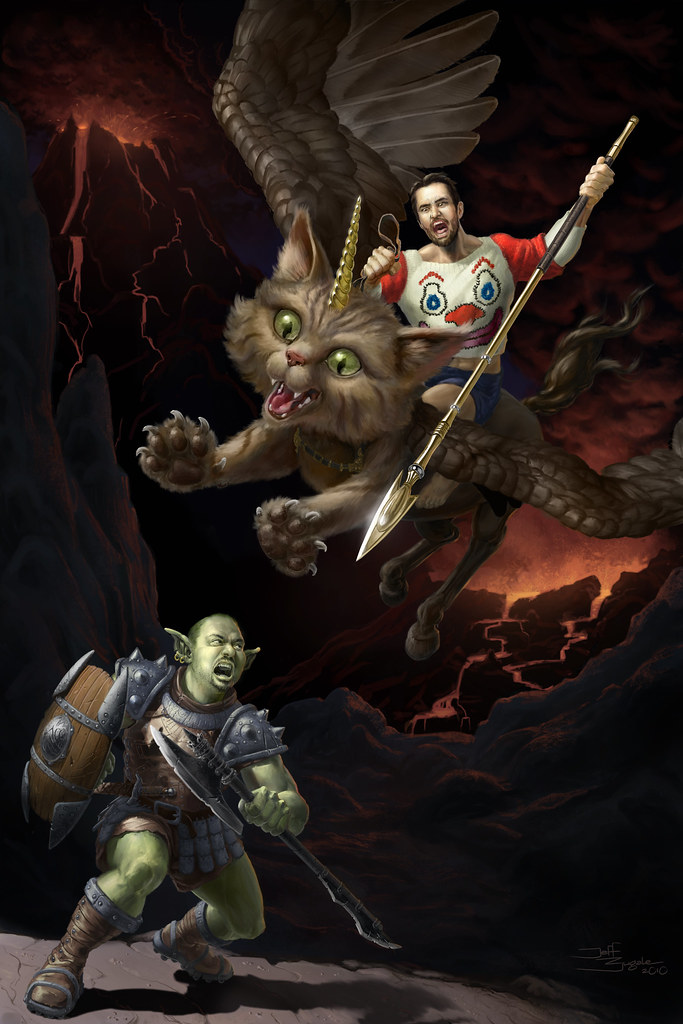
Actor Wil Wheaton and science-fiction author John Scalzi are running a fanfiction contest for charity. Entrants must come up with a short story to go with a gloriously ridiculous picture of a forbidding volcanic landscape, where Scalzi, with an ogre's greenish visage and battle armor, is about to engage in mortal combat with Wheaton, riding a giant winged cat. The subject matter may be unorthodox, but this is a fairly typical prompt for many writing contests and English assignments. I wouldn't have mentioned it here, except that Wheaton and Scalzi are specifically calling this a fanfiction contest, evoking the media fandom cultures that tend to form around major genre properties like "Star Trek," "Harry Potter," "Star Wars," and "Twilight."
The first thought that came to mind when I learned about the contest details was to question whether the contest entries should really be considered fanfiction. "Fanwork," an umbrella term that covers all fan-produced derivative media including written stories, videos, artwork, music, craft projects, and more esoteric items, covers a very broad spectrum. Anything inspired by existing source material could technically count as fanwork. Participants in Wheaton's and Scalzi's contest would base their work off of the picture provided, and presumably the personas of Wheaton and Scalzi themselves, who keep popular blogs and are well known in genre circles. Their existing fans will no doubt have a leg-up over those unfamiliar with their antics. And there's no requirement that the source material for fanfiction must be fictional. A whole subset of fanfiction known as "real person fiction" or RPS has flourished for years online, postulating on the activities of popular celebrities.
But then there's the question of the money. Wheaton and Scalzi announced that the contest winner will be paid for their work, at the rate of ten cents per word. Since the upper limit on story length is two-thousand words, the most that can possibly be paid out is the princely sum of
It's only when particularly ambitious fans like Steve Vander Ark, who tried to publish the "Harry Potter Lexicon," try to profit from successful fanwork that bitter lawsuits result. So understandably there's a deep-set aversion to any sort of monetization of fanfiction in the fan community. Many fan authors take pride in writing purely for the love of the source material and the gratification of their fellow fans. Some of the biggest fandoms have created a sort of gift economy centered around writing contests, challenges, and yearly holiday exchanges. The only exception I've seen is recent forays into fundraising, where popular authors will promise write-to-order stories in exchange for donations to noble causes. Legally there may not be much of a distinction, but socially it's more acceptable. There's also less of a stigma attached to selling fanart and crafts, probably because the cost of production is much higher.
Related to that point is the recognized professional/fan divide. Technically, tie-in novels, spinoffs, pastiches, parodies, tributes, reimaginings, reboots, and a lot of other writing could be considered fanfiction because it's derivative work based on previously established material. However, when it's officially sanctioned by the IP owner and money changes hands, the creators are no longer considered mere fans and their work is no longer thought of as fanwork. Or if the work falls into the parody or critique exceptions to copyright, or is simply based on source that has fallen out of copyright protection, there's no question as to its artistic legitimacy or kosher legal status - though the categorization can often seem pretty arbitrary. No doubt many of the professional writers who create such derivative works are fans of the originals, but few would expend so much time and energy on such works without hope of compensation. After all, writing is their livelihood.
Fanfiction, on the other hand, is by and large associated with amateur writers and hobbyists who do not expect to receive any acknowledgment, let alone approval from those associated with the original source material. Authors generally have no compunctions about breaking all sorts of rules regarding taste and subject matter for their own amusement. Pornographic stories are very popular. Self-insert protagonists, often derided as "Mary Sues" are common. Debates over a certain character's romantic preferences will often lead to reams of sappy love stories from all sides. The free-for-all atmosphere, lack of any kind of quality control or editing standards, and the proliferation of younger, untrained writers has given fanfiction a very bad reputation. The term "fanfiction" is synonymous in some places with the worst, unpublishable, bottom-feeder dreck. Yet there have been good stories produced from this culture that are all but indistinguishable in quality from professional work.
A showdown of sorts happened last month between Diana Gabaldon, the author of the popular "Outlander" novels, and members of the online fanfiction community after Gabaldon vehemently made known her dislike of fanfiction and those associated with it. The debate is still playing out, but what I concluded is that fanfiction not only does not require the original creator's approval or oversight, it thrives precisely because of its absence. The lack of imposed limitations allows for a freer exploration of fictional characters and universes in a way that would be impossible if fanfiction authors had to worry about pleasing the IP owners. The best fanfiction often functions as commentary, critique, wish-fulfillment, or simply a way for a fan to react to the original work. The lack of filters results in more bad stories than good, but also allows for more interesting work to emerge.
So the idea of officially sanctioned fanfiction feels counter-intuitive, though I don't think it's impossible. There have been attempts to corporatize fanfiction before, most recently with the heavily moderated FanLib Archive that went online in 2007. The corporately-backed project generated plenty of controversy, but failed to gain traction with writers or readers, and shortly collapsed in 2008. The fanfiction community has always existed comfortably outside of the mainstream, but it's become more and more visible in recent years with the increased interaction - and even cross-pollinization - of fans and creators in some fandoms. There's also at least one group, the Organization for Transformative Works (OTW) that seeks to establish the legality and legitimacy of fanworks, including fanfiction. But there's always the danger of clashes, of creator toes getting stepped on, or of certain fannish creative impulses getting quashed.
I'm sure John Scalzi and Wil Wheaton are completely well-meaning and just looking for a couple of laughs and a new way to connect with their fans, but like most they don't quite have a handle on the ins and outs of the fanfiction phenomenon yet. Or the terminology. The original rules for the contest prohibited "slash," a subgenre of fanfiction that explores homosexual relationships. This was quickly amended to prohibit explicit sexual material instead. It'll be interesting to see how this little experiment goes. What does fanfiction written for the subject of that fanfiction look like? What kind of effect will the involvement of the celebs have on the kind of fanfiction that is produced? They've already nixed the porn (not that anyone can ever *really* nix the porn). Will authors be stymied or emboldened? Will Wheatzi (or Scalton) take off as a new slash pairing? Will Dreamworks come after them for unauthorized use of "Shrek"?
I may have to enter this thing myself - just out of intellectual curiosity you understand.
Wednesday, June 2, 2010
The Grim World of "Harry Brown"
I ripped into the Liam Neeson action film "Taken" a few months ago, for being an especially slick revenge fantasy that used social ills for cheap dramatics and utterly failed to address any of the consequences of the main character's actions. Now this year, along comes "Harry Brown," a thematically similar vigilante picture that couldn't be more different in its approach. Where everything about "Taken" was polished and glib, "Harry Brown" offers a far more sobering glimpse of the ugly, unhappy circumstances that drive its hero to take the law into his own hands.
Much of the effectiveness of the film comes from Michael Caine, as the title character. We first see Harry Brown, an elderly pensioner, living a quiet, solitary life on a run-down council estate that is plagued with crime, vandalism, and drugs. His wife is in the hospital, for an unnamed illness that is progressively getting worse. His only friend is Leonard (David Bradley), another older gentleman from the estate who lives alone. During a meeting at the local pub, Leonard reveals that he's being tormented by a vicious gang of teenagers, and has taken to carrying around a bayonet for self-protection. The next day, Leonard is found stabbed to death, and an investigation is launched by the police, headed by Detective Inspector Frampton (Emily Mortimer) and Detective Sergeant Hicock (Charlie Creed-Miles).
At this point, your usual Hollywood action picture would set Harry Brown, outraged and righteous, on a quick path to revenge for his friend. It's to the film's credit that this does not happen. Instead, Brown is frightened and depressed by the crime. It's only after he finds out that the investigation is running in circles that he starts looking into the matter himself. And it's only by accident that he commits the first act of violence against a would-be mugger. When Brown does become angry and starts to seriously consider vigilantism, he's not equipped to simply go out and start raising hell, either mentally or physically. There is plenty of blood and guts when the time comes, but the buildup is slow, and the film makes sure that we get a good, long look at the depravity and vileness of Brown's targets before he starts shooting.
"Harry Brown" is often deeply unpleasant to watch, because it spends so much time observing the young gang members and petty criminals who infest the estate. The opening shots follow a gang initiation and then the horrific killing of an innocent bystander "for entertainment," as Brown later remarks. Through arrest and interrogation scenes, the major perpetrators are fleshed out enough to uncover the roots of their misanthropy. However, they receive little sympathy from the filmmakers or from Harry Brown. Director Daniel Barber makes them living extensions of the surrounding urban decay, their presence associated with the worst graffiti-slathered eyesores and ravaged properties. The environment is otherwise pervasively gray and lifeless, and even the untouched buildings appear on the verge of crumbling into permanent dilapidation.
In such an environment, the audience might expect Michael Caine to give us a resurrection of one of the steely-eyed men of violence he memorably portrayed in "The Italian Job" and "Get Carter," but this never quite happens. We learn early on that Harry Brown was once a Royal Marine, but he's in no hurry to revisit that part of himself, reluctant to even acknowledge the experience. Caine imbues Brown with a deep weariness, often appearing brow-beaten, afraid, and adrift. When his anger does surface, we sense it's backed by years of unspoken pain. Even when a particularly deserving fiend meets his end, there's no pleasure taken in the act - at most, Caine only lets us see brief, transient satisfaction. Compared to other recent film vigilantes, Harry Brown has the most in common with Jodie Foster's heroine from "The Brave One," whose unlikely campaign of anonymous justice was also begun with considerable trepidation.
The script is very good, and I appreciated that the writers took pains to demystify so many of the usual vigilante film cliches, though it doesn't deviate much from the usual formula. Harry Brown suffers from emphysema, and he does not fare well when trying to chase adolescent gang-bangers around the estate. And despite his knowledge of how to handle weapons, it takes considerable effort for him to procure one. The police are not portrayed as incompetent or corrupt, but rather misdirected and badly led. Though the climax gets over-dramatic, the film maintains a tone of realism throughout that is admirable, especially as to how violence is portrayed. Up-close, wince-inducing, and absolutely repellent, each slit throat and gunshot is designed to make viewers recoil. There's no anticipation of the "hot, red, moment" other genre products often employ.
When "Harry Brown" is focused on its main character, the film is excellent. The trouble is, a good chunk of the story is given over to the police investigators, Frampton and Hicock. They serve the function of collecting up bits of exposition we otherwise wouldn't be privy to, and provide reaction to other events in the narrative. It's not that these sequences are extraneous or badly executed, but they are very conventional and uninteresting to watch. Emily Mortimer is also an awful miscast as DI Frampton, looking so gloomy and oppressed in all her scenes, it's a mystery why she wants to stay in her department so badly. The rest of the cast is serviceable, but the younger newcomers should be singled out for praise for providing a good deal of genuine menace.
I doubt that "Harry Brown" is going to win over mainstream audiences. Its violence and grittiness will be too much for the older crowd who might come out for Michael Caine, and it'll probably be too slow and too stark for the usual action-movie crowd. The film succeeds as a solid social drama and character piece, but as it's being billed as a vigilante picture, so most viewers will be expecting something very different. On the other hand, those who want to see a vigilante movie would probably benefit the most from watching "Harry Brown," and getting a brutally realistic, non-romanticized take on the familiar formula.
Much of the effectiveness of the film comes from Michael Caine, as the title character. We first see Harry Brown, an elderly pensioner, living a quiet, solitary life on a run-down council estate that is plagued with crime, vandalism, and drugs. His wife is in the hospital, for an unnamed illness that is progressively getting worse. His only friend is Leonard (David Bradley), another older gentleman from the estate who lives alone. During a meeting at the local pub, Leonard reveals that he's being tormented by a vicious gang of teenagers, and has taken to carrying around a bayonet for self-protection. The next day, Leonard is found stabbed to death, and an investigation is launched by the police, headed by Detective Inspector Frampton (Emily Mortimer) and Detective Sergeant Hicock (Charlie Creed-Miles).
At this point, your usual Hollywood action picture would set Harry Brown, outraged and righteous, on a quick path to revenge for his friend. It's to the film's credit that this does not happen. Instead, Brown is frightened and depressed by the crime. It's only after he finds out that the investigation is running in circles that he starts looking into the matter himself. And it's only by accident that he commits the first act of violence against a would-be mugger. When Brown does become angry and starts to seriously consider vigilantism, he's not equipped to simply go out and start raising hell, either mentally or physically. There is plenty of blood and guts when the time comes, but the buildup is slow, and the film makes sure that we get a good, long look at the depravity and vileness of Brown's targets before he starts shooting.
"Harry Brown" is often deeply unpleasant to watch, because it spends so much time observing the young gang members and petty criminals who infest the estate. The opening shots follow a gang initiation and then the horrific killing of an innocent bystander "for entertainment," as Brown later remarks. Through arrest and interrogation scenes, the major perpetrators are fleshed out enough to uncover the roots of their misanthropy. However, they receive little sympathy from the filmmakers or from Harry Brown. Director Daniel Barber makes them living extensions of the surrounding urban decay, their presence associated with the worst graffiti-slathered eyesores and ravaged properties. The environment is otherwise pervasively gray and lifeless, and even the untouched buildings appear on the verge of crumbling into permanent dilapidation.
In such an environment, the audience might expect Michael Caine to give us a resurrection of one of the steely-eyed men of violence he memorably portrayed in "The Italian Job" and "Get Carter," but this never quite happens. We learn early on that Harry Brown was once a Royal Marine, but he's in no hurry to revisit that part of himself, reluctant to even acknowledge the experience. Caine imbues Brown with a deep weariness, often appearing brow-beaten, afraid, and adrift. When his anger does surface, we sense it's backed by years of unspoken pain. Even when a particularly deserving fiend meets his end, there's no pleasure taken in the act - at most, Caine only lets us see brief, transient satisfaction. Compared to other recent film vigilantes, Harry Brown has the most in common with Jodie Foster's heroine from "The Brave One," whose unlikely campaign of anonymous justice was also begun with considerable trepidation.
The script is very good, and I appreciated that the writers took pains to demystify so many of the usual vigilante film cliches, though it doesn't deviate much from the usual formula. Harry Brown suffers from emphysema, and he does not fare well when trying to chase adolescent gang-bangers around the estate. And despite his knowledge of how to handle weapons, it takes considerable effort for him to procure one. The police are not portrayed as incompetent or corrupt, but rather misdirected and badly led. Though the climax gets over-dramatic, the film maintains a tone of realism throughout that is admirable, especially as to how violence is portrayed. Up-close, wince-inducing, and absolutely repellent, each slit throat and gunshot is designed to make viewers recoil. There's no anticipation of the "hot, red, moment" other genre products often employ.
When "Harry Brown" is focused on its main character, the film is excellent. The trouble is, a good chunk of the story is given over to the police investigators, Frampton and Hicock. They serve the function of collecting up bits of exposition we otherwise wouldn't be privy to, and provide reaction to other events in the narrative. It's not that these sequences are extraneous or badly executed, but they are very conventional and uninteresting to watch. Emily Mortimer is also an awful miscast as DI Frampton, looking so gloomy and oppressed in all her scenes, it's a mystery why she wants to stay in her department so badly. The rest of the cast is serviceable, but the younger newcomers should be singled out for praise for providing a good deal of genuine menace.
I doubt that "Harry Brown" is going to win over mainstream audiences. Its violence and grittiness will be too much for the older crowd who might come out for Michael Caine, and it'll probably be too slow and too stark for the usual action-movie crowd. The film succeeds as a solid social drama and character piece, but as it's being billed as a vigilante picture, so most viewers will be expecting something very different. On the other hand, those who want to see a vigilante movie would probably benefit the most from watching "Harry Brown," and getting a brutally realistic, non-romanticized take on the familiar formula.
Tuesday, June 1, 2010
Are We Ready for a Black Spider-Man?
The search for an actor to play Spider-Man and his alter-ego Peter Parker, in Sony's upcoming reboot of the popular film franchise, took an interesting turn over the weekend. A list of young contenders has been circulating since last week, all of them gangly adolescents or young actors who could still pass for teenagers, including up-and-comers Jamie Bell and Josh Hutcherson. All of them were Caucasian, which is perfectly understandable because the character of Peter Parker was always Caucasian in the comic books and his subsequent film and TV appearances. But this did not stop Donald Glover (no relation to Danny Glover), an African-American actor best known for his comic role on NBC's "Community" and his stint with sketch comedy troupe Derrick Media, from launching a Twitter campaign to secure an audition for the role.
As much as some might like to think we're living in a post-racial America, this is sadly not the case, especially not in Hollywood. There's still a huge dearth of good onscreen roles for minorities, and a certain squeamishness to entertain the idea of race-neutral casting. When "racebending" does happen, there's a double standard that favors Caucasian actors. The controversy over the whitewashing of characters in "Prince of Persia" and "The Last Airbender," two of the summer's biggest tentpole pictures, escalated last week after the presence of minority actors was found suspiciously lacking upon the former film's release. "Prince" and "Airbender" take place in such noticeably Middle-Eastern and Asian settings, they would have been prime opportunities to see some underrepresented ethnic actors take the spotlight. No such luck.
The pendulum does swing the other way occasionally, and we have had a few initially Caucasian comic book characters like Nick Fury, Catwoman, and the villainous Kingpin portrayed by African-American actors. However, these are much rarer occurrences, and pains are usually taken to distinguish the ethnic versions from the Caucasian originals. Halle Berry's Catwoman was a new character named Patience Phillips, not the Selina Kyle Catwoman of the comics or the "Batman" films. The Nick Fury who appeared in the "Iron Man" films was based on a recent reinterpretation that the comics creators specifically based on the appearance of actor Samuel L Jackson. Similarly, headliners like Will Smith and Eddie Murphy have revived older franchises like "Wild, Wild West," "Doctor Dolittle," and "The Nutty Professor" with drastically rewritten lead characters.
No superhero as high profile as Spider-Man has ever been considered for this kind of ethnic reinvention, though there were rumors that Will Smith might take a shot at "Captain America," who has yet to appear in a major feature film. In some respects Spider-Man is a great choice for this, because the Spider-Man costume is a full body suit and mask that makes it impossible to tell the ethnicity of the person wearing it. Also, there's nothing inherently Caucasian about Peter Parker's background - he's a nerdy teenager who lives with his aunt and uncle. On the other hand, the viewing audience is already very familiar with the screen portrayal of Spider-Man as a Caucasian character. If a black actor does win the role, I suspect Sony would create a different persona separate from Peter Parker to lessen the potential confusion.
Still, I like the idea of having a Spider-Man of a different ethnicity, and I think Donald Glover is a great fit, though he's older than the other actors that Sony is purportedly considering. The reboot is a risky venture, coming so close on the heels of the successful Sam Raimi "Spider-Man" films. We've had second-tries at franchise flops and adaptations from different media that have been turned around in a shorter time frame, but rebooting from such a successful series like this is a unique situation. An African-American Spider-Man would help distinguish the next film from its predecessors, cement the new direction the franchise is taking, and offer different creative opportunities. Sony has the chance to do something genuinely interesting with the character, instead of reheating the leftovers of one of the biggest film trilogies in recent memory.
Realistically this is not likely to happen. Casting an unproven minority actor like Donald Glover would be a bold risk that the conservative financiers of the "Spider-Man" films will balk at. Though we have African-American stars like Denzel Washington and Will Smith who regularly carry action films, there's still a lingering tendency to think of projects starring minority actors as having more limited appeal, and filmmakers will only look at Caucasian actors unless a role is specifically tailored for a minority. When a film literally titled "Prince of Persia" has no principles of Middle-Eastern descent, it's difficult to imagine a black actor being given a real shot at playing everyone's favorite web-slinger.
Glover no doubt understands this, which is why his Twitter campaign is only lobbying for an audition rather than the role itself. Cynics might ask why he would even bother when he's such a long shot for the part, but I think it's a great move. This instantly raises his visibility, and puts the idea of race-neutral casting in people's minds. Even if Sony won't seriously consider him, the fanboys and the industry watchers have been buzzing over the possibility all weekend. I don't think Hollywood is ready for a black Spider-Man, but from some of the discussions I've been following, I think many of the rest of us might be. And that's something.
As much as some might like to think we're living in a post-racial America, this is sadly not the case, especially not in Hollywood. There's still a huge dearth of good onscreen roles for minorities, and a certain squeamishness to entertain the idea of race-neutral casting. When "racebending" does happen, there's a double standard that favors Caucasian actors. The controversy over the whitewashing of characters in "Prince of Persia" and "The Last Airbender," two of the summer's biggest tentpole pictures, escalated last week after the presence of minority actors was found suspiciously lacking upon the former film's release. "Prince" and "Airbender" take place in such noticeably Middle-Eastern and Asian settings, they would have been prime opportunities to see some underrepresented ethnic actors take the spotlight. No such luck.
The pendulum does swing the other way occasionally, and we have had a few initially Caucasian comic book characters like Nick Fury, Catwoman, and the villainous Kingpin portrayed by African-American actors. However, these are much rarer occurrences, and pains are usually taken to distinguish the ethnic versions from the Caucasian originals. Halle Berry's Catwoman was a new character named Patience Phillips, not the Selina Kyle Catwoman of the comics or the "Batman" films. The Nick Fury who appeared in the "Iron Man" films was based on a recent reinterpretation that the comics creators specifically based on the appearance of actor Samuel L Jackson. Similarly, headliners like Will Smith and Eddie Murphy have revived older franchises like "Wild, Wild West," "Doctor Dolittle," and "The Nutty Professor" with drastically rewritten lead characters.
No superhero as high profile as Spider-Man has ever been considered for this kind of ethnic reinvention, though there were rumors that Will Smith might take a shot at "Captain America," who has yet to appear in a major feature film. In some respects Spider-Man is a great choice for this, because the Spider-Man costume is a full body suit and mask that makes it impossible to tell the ethnicity of the person wearing it. Also, there's nothing inherently Caucasian about Peter Parker's background - he's a nerdy teenager who lives with his aunt and uncle. On the other hand, the viewing audience is already very familiar with the screen portrayal of Spider-Man as a Caucasian character. If a black actor does win the role, I suspect Sony would create a different persona separate from Peter Parker to lessen the potential confusion.
Still, I like the idea of having a Spider-Man of a different ethnicity, and I think Donald Glover is a great fit, though he's older than the other actors that Sony is purportedly considering. The reboot is a risky venture, coming so close on the heels of the successful Sam Raimi "Spider-Man" films. We've had second-tries at franchise flops and adaptations from different media that have been turned around in a shorter time frame, but rebooting from such a successful series like this is a unique situation. An African-American Spider-Man would help distinguish the next film from its predecessors, cement the new direction the franchise is taking, and offer different creative opportunities. Sony has the chance to do something genuinely interesting with the character, instead of reheating the leftovers of one of the biggest film trilogies in recent memory.
Realistically this is not likely to happen. Casting an unproven minority actor like Donald Glover would be a bold risk that the conservative financiers of the "Spider-Man" films will balk at. Though we have African-American stars like Denzel Washington and Will Smith who regularly carry action films, there's still a lingering tendency to think of projects starring minority actors as having more limited appeal, and filmmakers will only look at Caucasian actors unless a role is specifically tailored for a minority. When a film literally titled "Prince of Persia" has no principles of Middle-Eastern descent, it's difficult to imagine a black actor being given a real shot at playing everyone's favorite web-slinger.
Glover no doubt understands this, which is why his Twitter campaign is only lobbying for an audition rather than the role itself. Cynics might ask why he would even bother when he's such a long shot for the part, but I think it's a great move. This instantly raises his visibility, and puts the idea of race-neutral casting in people's minds. Even if Sony won't seriously consider him, the fanboys and the industry watchers have been buzzing over the possibility all weekend. I don't think Hollywood is ready for a black Spider-Man, but from some of the discussions I've been following, I think many of the rest of us might be. And that's something.
Subscribe to:
Posts (Atom)
